An out of service sign is one of the most overlooked yet critically important tools in any facility management, retail, hospitality, or industrial setting. Whether you manage a hospital, a restaurant, a gym, or a corporate office, there will be times when equipment breaks down, areas become unsafe, or services are temporarily unavailable. In those moments, a clear, well-placed out of service sign is the difference between an informed visitor and a serious liability incident.
These signs serve a dual purpose — they protect people from harm and communicate professionalism. Far too many businesses treat signage as an afterthought, slapping a piece of tape on a broken machine or scrawling “broken” on a sticky note. That approach invites accidents, complaints, and legal exposure. This article takes a thorough look at what out of service signs are, why they matter more than most people realize, what types exist, how to choose the right one, and where to get the best ones for your specific needs.
What Is an Out of Service Sign?
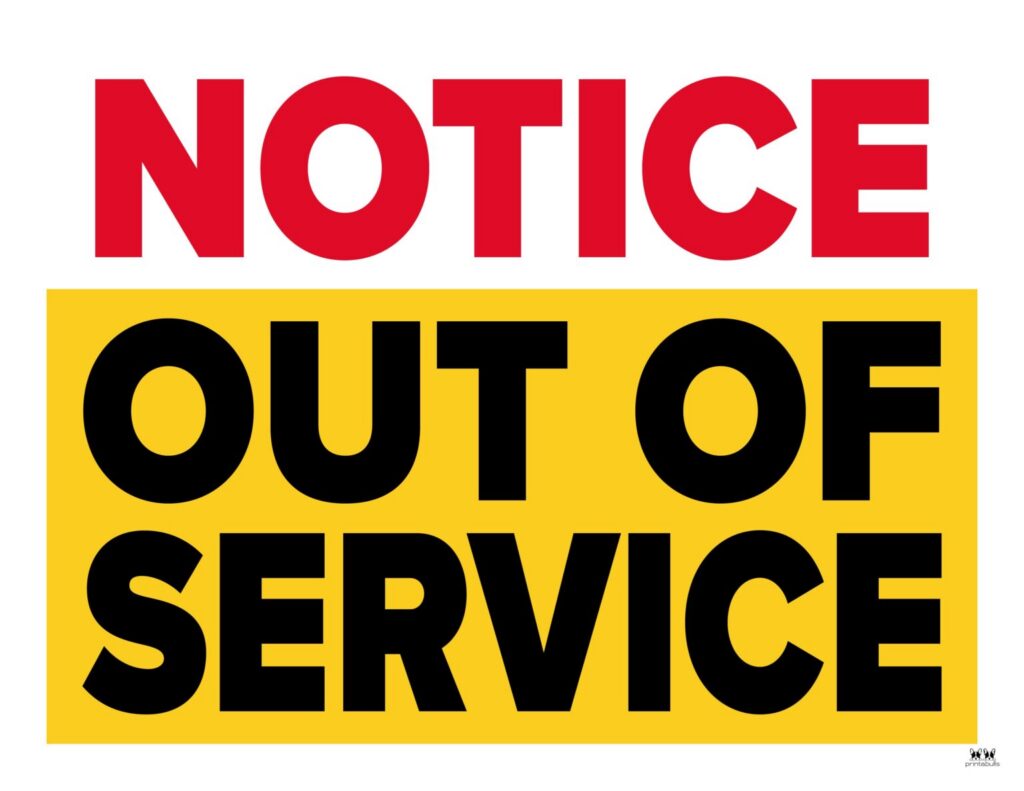
An out of service sign is a visual communication tool used to inform employees, customers, or the general public that a specific piece of equipment, area, fixture, or service is temporarily unavailable for use. These signs play a central role in safety compliance, operational communication, and risk management across virtually every industry. The term “out of service” itself is universally understood — it instantly communicates that whatever it is attached to should not be used, accessed, or relied upon until further notice.
These signs range from simple printed paper notices to highly durable, laminated, or metal-plated professional-grade signage. They can be freestanding, adhesive-backed, hanging, or magnetic. What remains constant across all formats is their core function: to stop people from interacting with something that is broken, unsafe, or intentionally taken offline. In industries where regulatory compliance is critical — such as healthcare, food service, aviation, and manufacturing — out of service signs are not optional courtesies. They are mandatory safety devices governed by standards set by organizations like OSHA (Occupational Safety and Health Administration) and ANSI (American National Standards Institute).
Why Out of Service Signs Are More Important Than You Think
Many business owners underestimate the importance of proper out of service signage until something goes wrong. A customer trips on a broken escalator step that had no sign. An employee uses a faulty piece of machinery because there was no clear indication it was under repair. A restroom patron slips on a wet floor because a cleaning crew forgot to post a sign. These scenarios happen daily, and they are entirely preventable.
Here are the key reasons why out of service signs are essential:
- Legal Liability Protection: A properly placed out of service sign documents that a business took reasonable steps to warn individuals of a hazard. This is a critical layer of legal protection in personal injury lawsuits.
- OSHA Compliance: OSHA’s lockout/tagout standards (29 CFR 1910.147) specifically require that equipment undergoing service or maintenance be clearly marked to prevent accidental start-up or use.
- Reputation Management: A business that handles equipment failures professionally — with clear, clean signage — communicates competence and care to customers.
- Employee Safety Culture: When workers see proper signage consistently used, it reinforces a culture where safety is taken seriously.
- Operational Efficiency: Clear out of service signs reduce confusion, prevent repeated questions to staff, and allow teams to focus on fixing the problem rather than managing crowd control around it.
“The goal of safety signage is not just to warn — it is to guide behavior and prevent harm before it happens.” — National Safety Council
Types of Out of Service Signs You Should Know
Not all out of service signs are the same. The right type depends on your industry, the environment where it will be used, and the nature of the equipment or area being marked. Below is a comprehensive breakdown of the most common types.
1. Equipment Out of Service Signs
These signs are designed to be attached directly to a machine, appliance, or piece of equipment that is broken or under maintenance. They are commonly used in:
- Manufacturing plants
- Gyms and fitness centers (for treadmills, weight machines, etc.)
- Laundromats (washers and dryers)
- Office environments (printers, copiers, coffee machines)
- Hospitals (medical devices, imaging equipment)
Equipment out of service signs typically include a bold header (“OUT OF SERVICE”), a brief explanation field, a date field, and sometimes a signature or contact line. Many are designed as tags that hang from a handle or machine arm.
Suggested read: Wall Street Customer Service: Everything You Need to Know Before You Call
2. Restroom Out of Service Signs
Restroom closures require quick, clear communication — especially in high-traffic public spaces. Restroom out of service signs are commonly used when:
- A toilet, sink, or fixture is broken
- The entire restroom is undergoing cleaning or maintenance
- A plumbing issue requires temporary closure
- A health or hygiene issue requires remediation
These signs are often freestanding A-frame boards, door hanger signs, or cone-top signs that can be quickly deployed and removed.
3. Elevator Out of Service Signs
Elevator outages affect building accessibility and can be a major inconvenience, particularly in buildings with elderly or disabled occupants. Elevator out of service signs must be large enough to be seen from a distance and should include:
- Clear “OUT OF SERVICE” or “ELEVATOR OUT OF SERVICE” header
- Expected return-to-service date (if known)
- Alternative access instructions (e.g., “Please use stairwell on east side”)
- Contact information for questions
Failure to properly mark an out-of-service elevator in a public building can result in ADA (Americans with Disabilities Act) compliance violations.
4. ATM Out of Service Signs
Banks, retailers, and ATM operators use out of service signs when their machines experience technical faults or require maintenance. A well-designed ATM out of service sign:
- Uses brand-consistent colors and fonts
- Provides an alternative location for cash withdrawal
- Includes a customer service contact number
- Maintains a professional, apologetic tone
5. Pump Out of Service Signs (Gas Stations)
Gas stations and fuel depots use pump out of service signs when a dispenser is faulty, dry, or under maintenance. These are typically:
- Weatherproof vinyl or plastic signs
- Secured with bag-style covers that slide over the pump handle
- Bright orange or red to maximize visibility
6. Lockout/Tagout Signs
Lockout/tagout (LOTO) signs are a specialized form of out of service sign used in industrial and manufacturing environments. They are legally required by OSHA and are used in conjunction with physical locks to prevent hazardous energy from being released during equipment maintenance. These signs must meet ANSI Z244.1 standards.
Out of Service Sign Design: What Makes One Effective?
The design of an out of service sign directly impacts how well it communicates. A poorly designed sign — one that is too small, uses hard-to-read fonts, or lacks contrast — defeats its own purpose. Here are the core design principles that make an out of service sign truly effective.
Color and Contrast
- Red or Orange signals danger or immediate stop — ideal for hazardous equipment
- Yellow signals caution — suitable for temporarily unavailable areas
- Blue signals information — often used for equipment or service notices in corporate settings
- White on Black or Black on Yellow offers maximum contrast and readability at distance
Font and Readability
- Use bold, sans-serif fonts (such as Arial Black, Helvetica, or Impact) for maximum legibility
- The primary message (“OUT OF SERVICE”) should be at least 48–72 pt font size for visibility
- Avoid decorative or script fonts — they reduce readability under stress or at distance
Icons and Symbols
- A universal “no” symbol (circle with diagonal line) is globally recognized
- A wrench or tools icon communicates maintenance context
- An exclamation point within a triangle communicates caution
Durability and Material
| Material | Best For | Weather Resistant? |
|---|---|---|
| Paper/Cardstock | Temporary indoor use | No |
| Laminated Cardstock | Short-term indoor/outdoor | Mild |
| Rigid Plastic (PVC) | Long-term indoor use | Yes (light) |
| Aluminum/Metal | Industrial/outdoor use | Yes (heavy duty) |
| Vinyl Adhesive | Equipment tagging | Yes |
| Magnetic | Metal surfaces, reusable | Yes |
Industry-Specific Use Cases for Out of Service Signs
Healthcare and Hospitals
In a healthcare setting, using the wrong equipment can have life-or-death consequences. Out of service signs in hospitals and clinics must be immediately visible, clearly worded, and used consistently across departments. Biomedical engineering teams routinely tag malfunctioning devices — from IV pumps to patient beds — with out of service tags that include the date of removal, the reason, and the technician’s ID. The Joint Commission (TJC) inspects healthcare facilities for proper equipment tagging compliance as part of accreditation reviews.
A 2021 report by the ECRI Institute identified improper use of tagged-out medical equipment as a contributing factor in 12% of preventable medical device-related incidents in hospital settings. This statistic underscores how vital consistent out of service signage practices are in clinical environments.
Hospitality and Food Service
Hotels, restaurants, and food service operations rely heavily on equipment — from commercial dishwashers and refrigeration units to elevators and swimming pools. An out of service sign in this context does double duty: it keeps guests and staff safe, and it manages guest expectations. A hotel that clearly marks an “OUT OF SERVICE — ELEVATOR” sign and provides alternative directions appears far more professional than one where guests discover the problem themselves after waiting several minutes.
Suggested read: Attic Cleaning Services: Everything You Need to Know Before Hiring a Pro
Case Study: Major Hotel Chain Elevator Signage Policy
A large international hotel chain with over 500 properties implemented a standardized out of service sign protocol in 2019 after a guest injury incident at one of their properties. The guest had attempted to use an elevator that was undergoing maintenance but lacked proper signage. Following a costly legal settlement, the chain:
- Issued branded, laminated elevator out of service signs to all properties
- Required a signed maintenance log to accompany every sign deployment
- Trained all front desk and maintenance staff on signage procedures
Result: Zero reported elevator-related guest incidents in the 24 months following implementation.
Retail and Grocery
In retail environments, self-checkout kiosks, shopping cart corrals, escalators, and refrigeration units routinely go out of service. Grocery chains in particular use high-visibility out of service signs on refrigerated display cases when compressors fail — this is both a food safety measure and a customer communication tool. Well-designed retail out of service signs include:
- “We’re sorry for the inconvenience” messaging to maintain customer goodwill
- A team member contact direction (“See a team member for assistance”)
- Estimated return to service time when available
Gyms and Fitness Centers
Fitness equipment out of service signs are among the most commonly needed signs in any gym or health club. Treadmills, ellipticals, cable machines, and weight benches all experience regular wear and tear. A gym that leaves broken equipment on the floor without signage risks injury, liability claims, and negative reviews.
Best practices for gym out of service signs:
- Use bright, high-visibility colors (red or orange) to ensure the sign is noticed
- Include the date the equipment was taken out of service
- Provide an estimated repair completion date if possible
- Direct members to alternative equipment or a staff member
How to Choose the Right Out of Service Sign for Your Needs
Choosing the right sign means asking the right questions first. Here is a decision framework to guide your selection:
Step 1: Identify the environment Is the sign going indoors or outdoors? Will it be exposed to moisture, chemicals, or extreme temperatures? Industrial environments need metal or heavy-duty vinyl. Indoor office settings can use laminated cardstock.
Step 2: Determine the duration of use Is this a one-time emergency use, or will the sign be used repeatedly? Reusable signs with write-on/wipe-off surfaces or magnetic backing are more economical for recurring needs.
Step 3: Consider the audience Is your audience English-speaking only, or do you need multilingual signs? Do you serve a population with visual impairments who may benefit from Braille or high-contrast designs? ADA compliance may be a factor.
Step 4: Check regulatory requirements Does your industry have specific OSHA, ANSI, or accreditation body requirements for signage? Lockout/tagout signs must meet ANSI Z244.1. Healthcare signs may need to meet Joint Commission standards.
Suggested read: What Is Amazon Digital Services? Everything You Need to Know in 2025
Step 5: Match the sign to the surface Will the sign be hanging, freestanding, adhesive-backed, or magnetic? Ensure the sign’s mounting method is compatible with the surface it will be placed on.
Out of Service Sign Standards and Compliance
OSHA Regulations
OSHA’s 29 CFR 1910.147 — the Control of Hazardous Energy standard — is the primary regulation governing the use of out of service and lockout/tagout signs in workplace environments. Key requirements include:
- Tags (signs) must be legible and understandable by all authorized employees
- Tags must warn against hazardous conditions and include appropriate warnings such as “DO NOT OPERATE” or “DO NOT START”
- Tags must be standardized within a facility in at least one of the following criteria: color, shape, or size; and they must include print and format
Failure to comply with OSHA 29 CFR 1910.147 can result in penalties of up to $15,625 per violation for serious violations and up to $156,259 per violation for willful or repeated violations (as of 2024 adjusted penalty amounts).
ANSI Standards
The American National Standards Institute provides standards for safety signs through ANSI Z535 — a series of standards covering safety color codes, environmental and facility safety signs, product safety signs and labels, and more. Key ANSI Z535 requirements for out of service signs include:
- Use of a signal word panel (DANGER, WARNING, CAUTION, NOTICE)
- Consistent use of defined safety colors
- Clear message panel with hazard description and avoidance instructions
Out of Service Sign Cost Guide: What Should You Expect to Pay?
Pricing for out of service signs varies widely based on material, quantity, and customization. Here is a general pricing overview:
| Sign Type | Average Cost per Unit | Quantity Discount Available? |
|---|---|---|
| Paper/Printable Template | $0 – $5 | N/A |
| Laminated Cardstock Sign | $5 – $15 | Yes (bulk orders) |
| Rigid Plastic Sign | $10 – $30 | Yes |
| Metal/Aluminum Sign | $20 – $60 | Yes |
| Magnetic Sign | $15 – $40 | Yes |
| Customized Branded Sign | $30 – $100+ | Yes (volume pricing) |
| Lockout/Tagout Tag Sets | $20 – $80 (per set) | Yes |
For large facilities or multi-location businesses, investing in custom-branded, durable out of service signs is far more cost-effective in the long run than repeatedly purchasing disposable alternatives.
Where to Buy Out of Service Signs
There are several reliable sources for purchasing out of service signs, ranging from online retailers to specialty safety suppliers:
- SafetySign.com — One of the largest dedicated online safety sign retailers; offers standard and custom options
- Amazon Business — Wide selection of signs at various price points with bulk ordering
- Grainger — Industrial-grade signs ideal for manufacturing and warehouse environments
- Uline — Popular for businesses needing signs in bulk at competitive prices
- ComplianceSigns.com — Specializes in OSHA and ANSI-compliant signage
- Brady Corporation — Industry leader in industrial identification products including lockout/tagout tags
- Local print shops — Ideal for short runs of custom or branded signs
When purchasing, always verify that the sign meets the regulatory requirements applicable to your industry before deploying it.
Printable Out of Service Sign Templates: A Practical Option
For businesses that need an immediate solution — or for low-traffic, temporary situations — printable out of service sign templates offer a fast and free option. Many websites offer free downloadable templates in PDF or Word format that can be printed and laminated. While these are not a substitute for professional-grade signage in regulated industries, they serve well for:
- Office equipment (printers, coffee machines, microwaves)
- Internal facility use in low-risk environments
- Emergency short-term deployment while permanent signs are ordered
Tips for using printable templates effectively:
- Print in color — black-and-white signs are significantly less noticeable
- Use at least cardstock paper for sturdiness; avoid standard printer paper
- Laminate the sign if it will be used for more than a day or in humid conditions
- Include the date and a brief reason for the outage
- Sign or initial the tag so there is a record of who deployed it
Out of Service Sign vs. Do Not Use Sign: Is There a Difference?
These two sign types are often confused or used interchangeably, but there is a meaningful distinction between them:
Suggested read: Moving Services Greenville: Everything You Need to Know About Professional Movers in 2024
| Feature | Out of Service Sign | Do Not Use Sign |
|---|---|---|
| Primary Message | Equipment is broken/unavailable | Equipment must not be used (safety hazard) |
| Urgency Level | Moderate | High |
| Typical Context | Maintenance, repair, temporary outage | Active danger, regulatory lockout |
| Regulatory Implication | Generally informational | Often legally mandated (OSHA LOTO) |
| Common Color | Yellow, Blue, Red | Red, Orange |
Understanding this distinction helps ensure your signage correctly communicates the level of risk and the reason for the restriction.
The Role of Digital Out of Service Notifications
In 2025 and beyond, physical out of service signs are increasingly complemented by digital notifications. Many businesses now use:
- Digital display screens mounted near equipment to show out of service status dynamically
- QR codes on physical signs linking to a maintenance ticket or status page
- Mobile app alerts for members of gyms, co-working spaces, or campus facilities
- Email and SMS notifications for services like ATMs, vending machines, and parking systems
This hybrid approach — physical signage plus digital communication — creates multiple touchpoints that ensure the message is received, regardless of whether a person checks their phone or walks past a sign. Smart building platforms like IBM TRIRIGA, Archibus, and Eptura (formerly iOFFICE) now include automated signage management features that can trigger out of service notices across both physical and digital channels simultaneously when a maintenance ticket is logged.
How Proper Out of Service Signage Supports Your SEO and Online Reputation
This may seem like an unusual connection, but it is real: how your business handles equipment failures — including your signage — directly affects your online reputation, which in turn impacts your local SEO performance. Here is how:
- Businesses that handle breakdowns poorly receive negative reviews on Google, Yelp, and TripAdvisor
- Negative reviews lower your average star rating, which affects click-through rates from Google Business Profile listings
- Lower click-through rates signal to Google that your listing is less relevant, impacting your local search ranking
Conversely, businesses that handle issues professionally — with clear signage, apologies, and helpful alternatives — tend to receive positive feedback that mentions their responsiveness. These positive signals support local SEO performance.
If you want to go even deeper into how your business’s online presence and content can be optimized, consider working with professional seo copywriting services that specialize in reputation management and local search optimization.
Facts and Statistics About Workplace Safety Signage
Understanding the numbers behind workplace signage reinforces why investing in proper out of service signs is not optional:
- 📊 OSHA reports that inadequate safety warning systems are among the top 10 most cited violations every year across American workplaces
- 📊 According to the National Safety Council, workplace injuries cost U.S. employers $167 billion in 2022, including wage losses, medical expenses, and administrative costs
- 📊 Studies show that properly placed safety signs reduce workplace accidents by up to 78% when combined with adequate training
- 📊 In 2023, OSHA issued over 4,800 violations specifically related to energy control procedures (lockout/tagout), with total penalties exceeding $10 million
- 📊 The average cost of a single workplace injury claim in the U.S. is $41,353, according to the National Safety Council’s 2023 Injury Facts report
- 📊 Facilities that conduct regular safety audits, including signage inspections, experience 35% fewer recordable incidents than those that do not (EHS Today, 2022)
Common Mistakes to Avoid With Out of Service Signs
Even businesses that invest in proper out of service signage sometimes make avoidable mistakes. Here are the most common errors and how to prevent them:
Mistake 1: Using the Wrong Sign for the Hazard Level
Placing a general “Out of Service” sign on equipment that poses an active electrical or mechanical hazard — when a lockout/tagout procedure is required — is both dangerous and a compliance violation. Always match the sign to the actual risk level.
Mistake 2: Not Including a Date
An undated out of service sign gives no context. Does this machine go out of service today, or has it been broken for three months? A date helps maintenance teams track issues and gives users a sense of urgency. Always include the date the sign was deployed.
Mistake 3: Placing Signs in Poor Locations
A sign taped to the back of a machine that users approach from the front will not be seen. Place signs at eye level, at the primary point of interaction with the equipment.
Suggested read: Everything You Need to Know About Professional Repiping Services for Your Home
Mistake 4: Using Faded or Damaged Signs
A faded, torn, or barely legible sign is almost as bad as no sign at all. Signs should be replaced when they show visible wear. Conduct regular signage audits as part of your facility management routine.
Mistake 5: Forgetting to Remove the Sign When Equipment is Repaired
Leaving an out of service sign on equipment that has been fixed creates confusion and undermines trust in your signage system. Establish a clear sign removal protocol as part of your maintenance completion checklist.
Out of Service Sign Best Practices: A Quick Reference Checklist
Use this checklist to ensure your organization is using out of service signs correctly and consistently:
- [ ] Signs are compliant with OSHA/ANSI requirements for your industry
- [ ] Signs are made of materials appropriate for the environment (indoor vs. outdoor, wet vs. dry)
- [ ] Signs include the date of deployment
- [ ] Signs are placed at the primary point of user interaction with the equipment
- [ ] Signs include a brief explanation or contact information
- [ ] Signs are legible from at least 3–5 feet away
- [ ] Damaged or faded signs are replaced immediately
- [ ] A sign removal procedure is in place and followed after repairs
- [ ] Staff are trained on when and how to deploy signs
- [ ] A log is maintained for all sign deployments (especially for regulated industries)
🛒 Ready to Get Your Out of Service Sign?
Don’t wait for an incident to remind you why proper signage matters. Whether you need a single sign for your office printer or a bulk order of OSHA-compliant lockout/tagout tags for an industrial facility, the right out of service sign is an investment in safety, compliance, and professionalism that pays for itself many times over.
Browse our curated recommendations and find the perfect out of service sign for your space today. Your team, your customers, and your legal team will thank you.
Frequently Asked Questions About Out of Service Signs
What does an out of service sign mean?
An out of service sign indicates that a piece of equipment, machine, fixture, or area is temporarily unavailable for use. It communicates that the item is broken, under maintenance, or deliberately taken offline, and warns users not to attempt to use it until the sign is removed.
Is it legally required to post an out of service sign?
In many regulated industries and contexts, yes — it is legally required. OSHA’s lockout/tagout standard (29 CFR 1910.147) mandates the use of warning tags on equipment undergoing maintenance or repair in workplace settings. In other contexts, while not always explicitly required by law, failing to post a sign when equipment is hazardous can expose a business to significant legal liability.
Where should I place an out of service sign?
An out of service sign should always be placed at the primary point of interaction — where a user would first approach or attempt to operate the equipment. For large equipment, signs should be placed at every access point. For doors or areas, signs should be posted at eye level at the entrance.
Can I print my own out of service sign?
Yes, for low-risk, non-regulated environments, a printed out of service sign is acceptable. However, for workplaces covered by OSHA regulations, signs must meet specific standards for color, wording, and format. Printable templates are best used as temporary measures while professional signs are ordered.
How is an out of service sign different from a lockout/tagout tag?
An out of service sign is a general-purpose notice that equipment is unavailable. A lockout/tagout tag is a specific type of out of service tag used in conjunction with a physical lock in industrial settings to prevent the release of hazardous energy during equipment maintenance. Lockout/tagout tags are governed by strict OSHA and ANSI standards and carry legal compliance requirements.
What should an out of service sign include?
At minimum, an effective out of service sign should include: a clear “OUT OF SERVICE” header, the date the sign was placed, a brief reason for the outage (if possible), contact information or instructions for assistance, and — in regulated environments — the name or ID of the person who deployed the sign.
Suggested read: Service Due Soon B1: Everything You Need to Know About Honda's B1 Maintenance Alert
Where can I buy a quality out of service sign?
Quality out of service signs are available from dedicated safety supply retailers such as SafetySign.com, ComplianceSigns.com, and Brady Corporation, as well as general retailers like Amazon Business, Grainger, and Uline. For custom or branded signs, local print shops or specialty sign companies are also excellent options.
Citation: SafetySign.com. (2024). Out of Service Signs. Safety Sign Company. Retrieved July 2025.